Languages
PyTorch Cheat Sheet
Print-ready cheat sheet for PyTorch, organized for fast lookup, study, and desk-side use
Sample
What's in this cheat sheet
- Tensors
- Autograd
- Neural Networks
- Data Loading
- Training Loop
- Optimizers
- Loss Functions
- Saving & Loading
- GPU
- Common Patterns
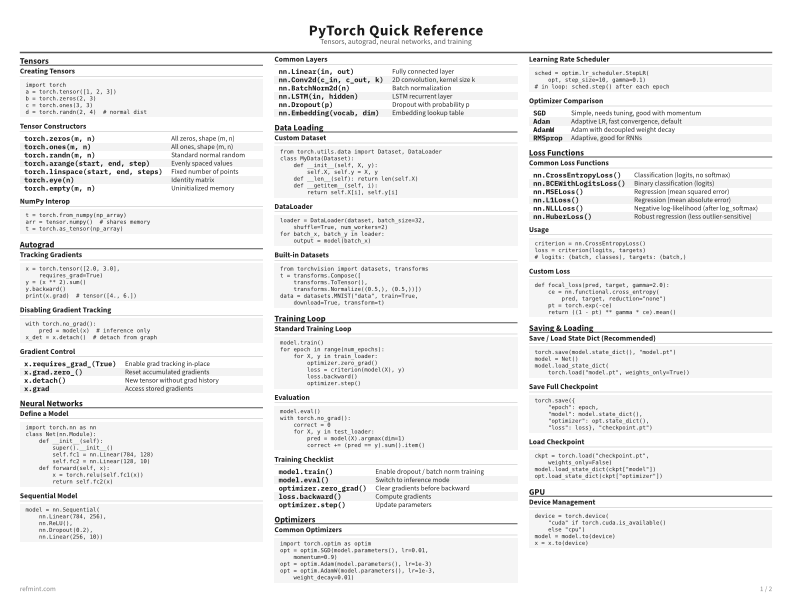
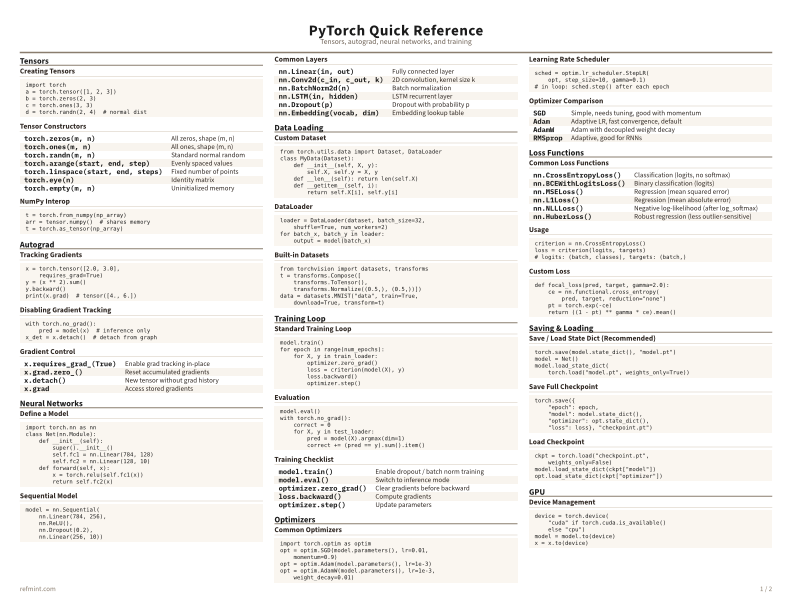
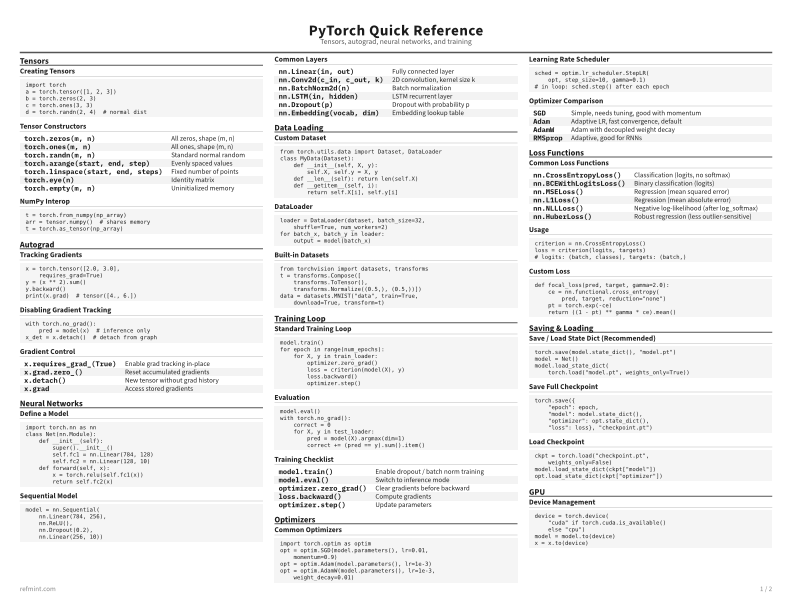
Creating Tensors
import torch
a = torch.tensor([1, 2, 3])
b = torch.zeros(2, 3)
c = torch.ones(3, 3)
d = torch.randn(2, 4)  # normal dist
Tensor Constructors
torch.zeros(m, n) | All zeros, shape (m, n) |
torch.ones(m, n) | All ones, shape (m, n) |
torch.randn(m, n) | Standard normal random |
torch.arange(start, end, step) | Evenly spaced values |
torch.linspace(start, end, steps) | Fixed number of points |
torch.eye(n) | Identity matrix |
torch.empty(m, n) | Uninitialized memory |
NumPy Interop
t = torch.from_numpy(np_array)
arr = tensor.numpy()  # shares memory
t = torch.as_tensor(np_array)
Download the full cheat sheet for all sections, formatted for print
Download PDFDownloads
Choose the treatment that matches how you read
-
Recommended
Standard
B&W, ink-efficient. The default for laser printers and photocopies
Best for Printouts and desk-side reference
-
Color
Warm color accents for on-screen reading or color printers
Best for Screen reading or color printers
-
Reference Card
Maximum density, 4-column layout. Everything on one page
Best for Fast scanning and minimum paper use